Matera & Puglia 7-Day Route: Sassi Cave Dwellings, Trulli Towns & Limestone Coves
A researched 7-day Matera and Puglia itinerary covering Sassi cave hotel neighborhoods, Palombaro Lungo cisterns, Alberobello, Polignano a Mare, Lecce, and 2026 costs.
7 Days
Rental Car + Regional Rail
Mediterranean (40.67° N)
$130–$230/day
April–June & September–October
Episode 06 · Field Studies
Matera & Puglia Field Photography
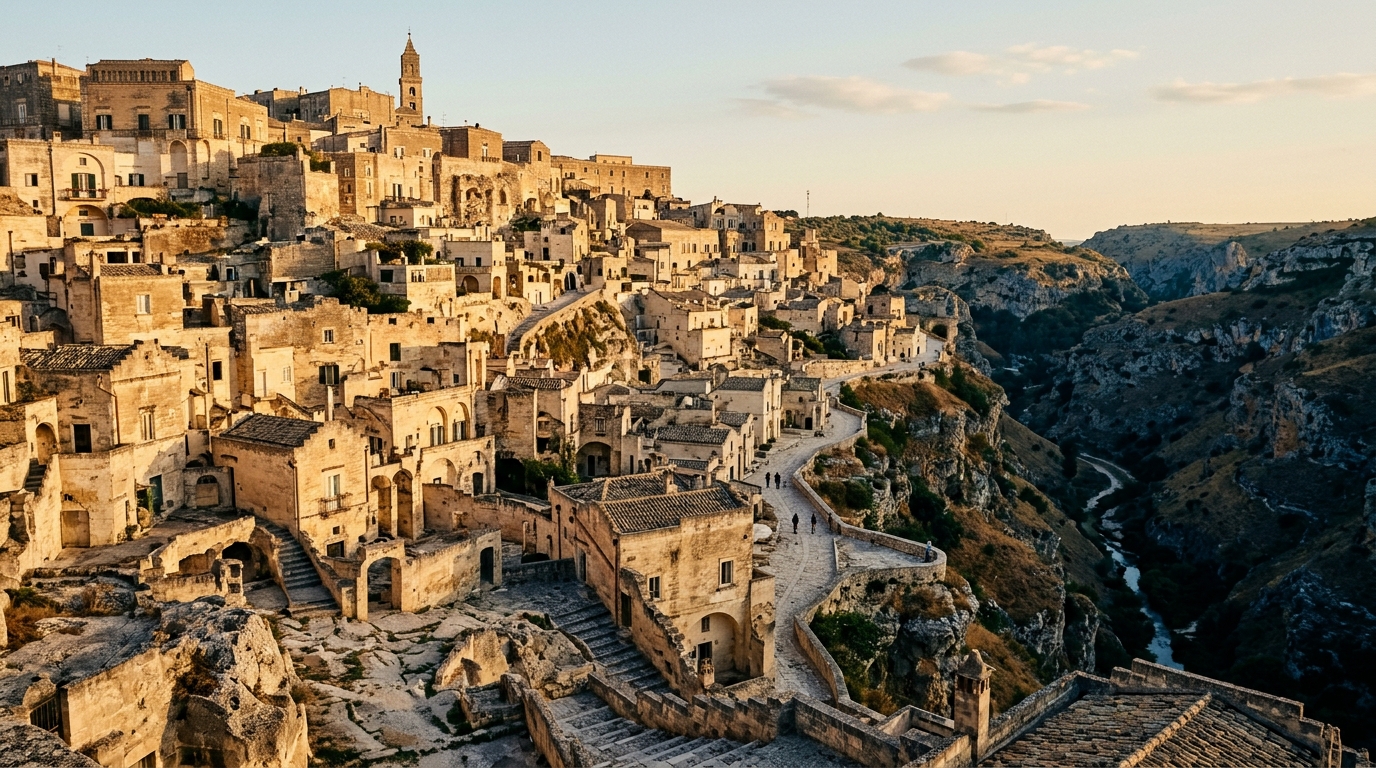
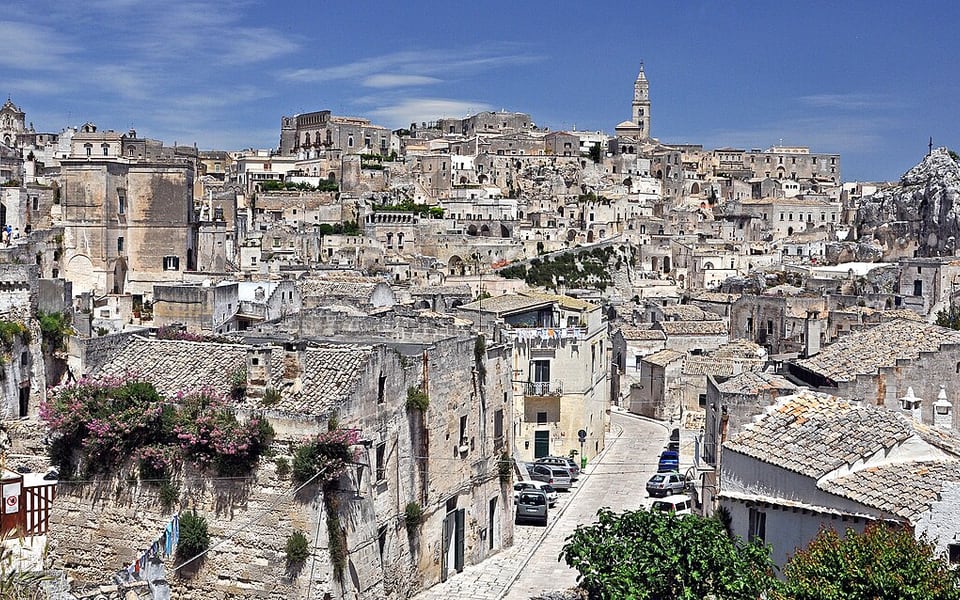
Matera's Sassi quarters carved into calcarenite terraces above the Gravina gorge.
Jules Verne Times Two (CC BY-SA 4.0, Wikimedia Commons)
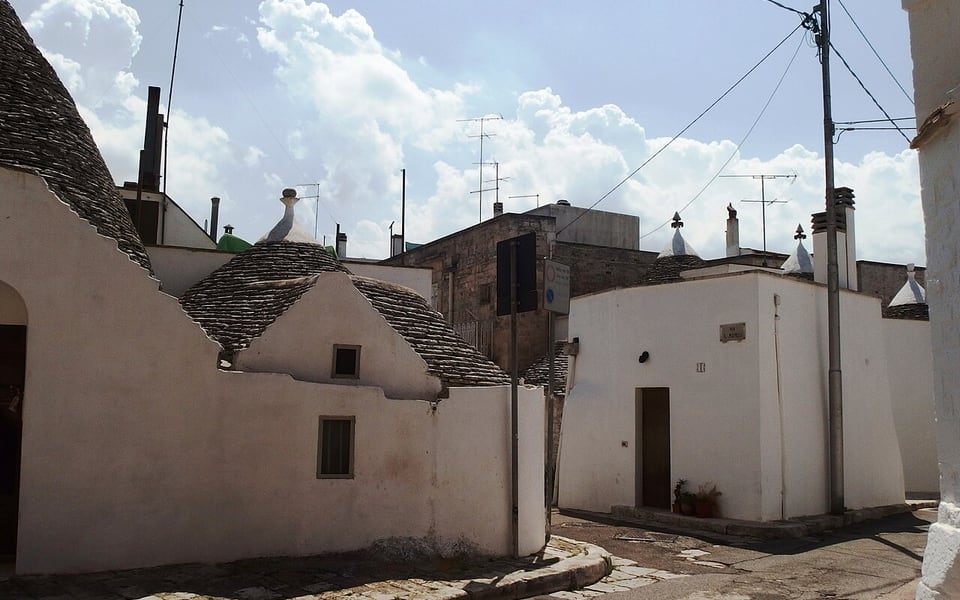
Mortar-free corbeled limestone trulli roofs across Rione Monti in Alberobello.
Palickap (CC BY-SA 4.0, Wikimedia Commons)
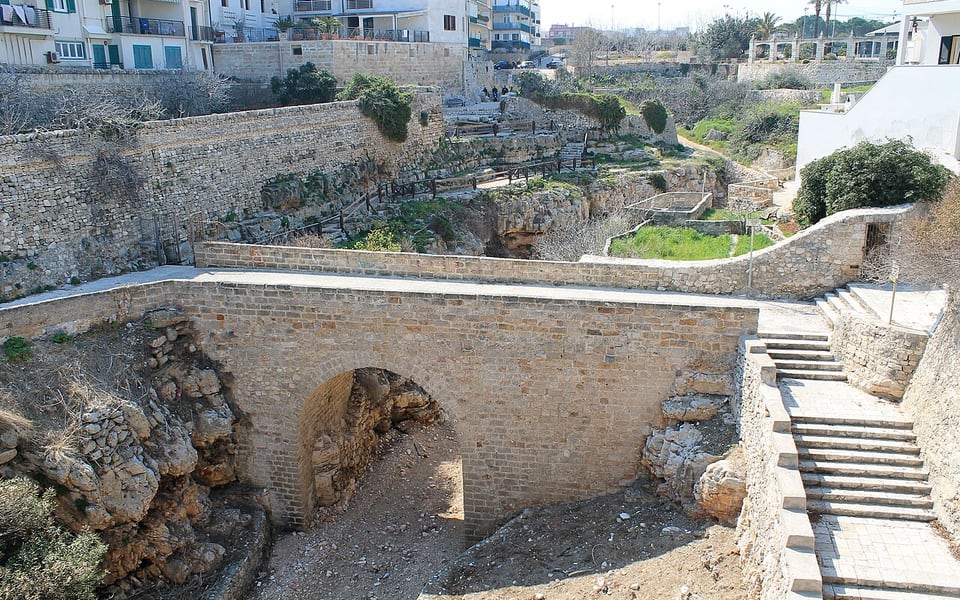
Lama Monachile inlet and overhanging cliff houses in Polignano a Mare.
Marzano Enrico (CC BY-SA 4.0, Wikimedia Commons)
Original Cartography & Engineering Plate
Visual Atlas & Embeddable Route Infographic
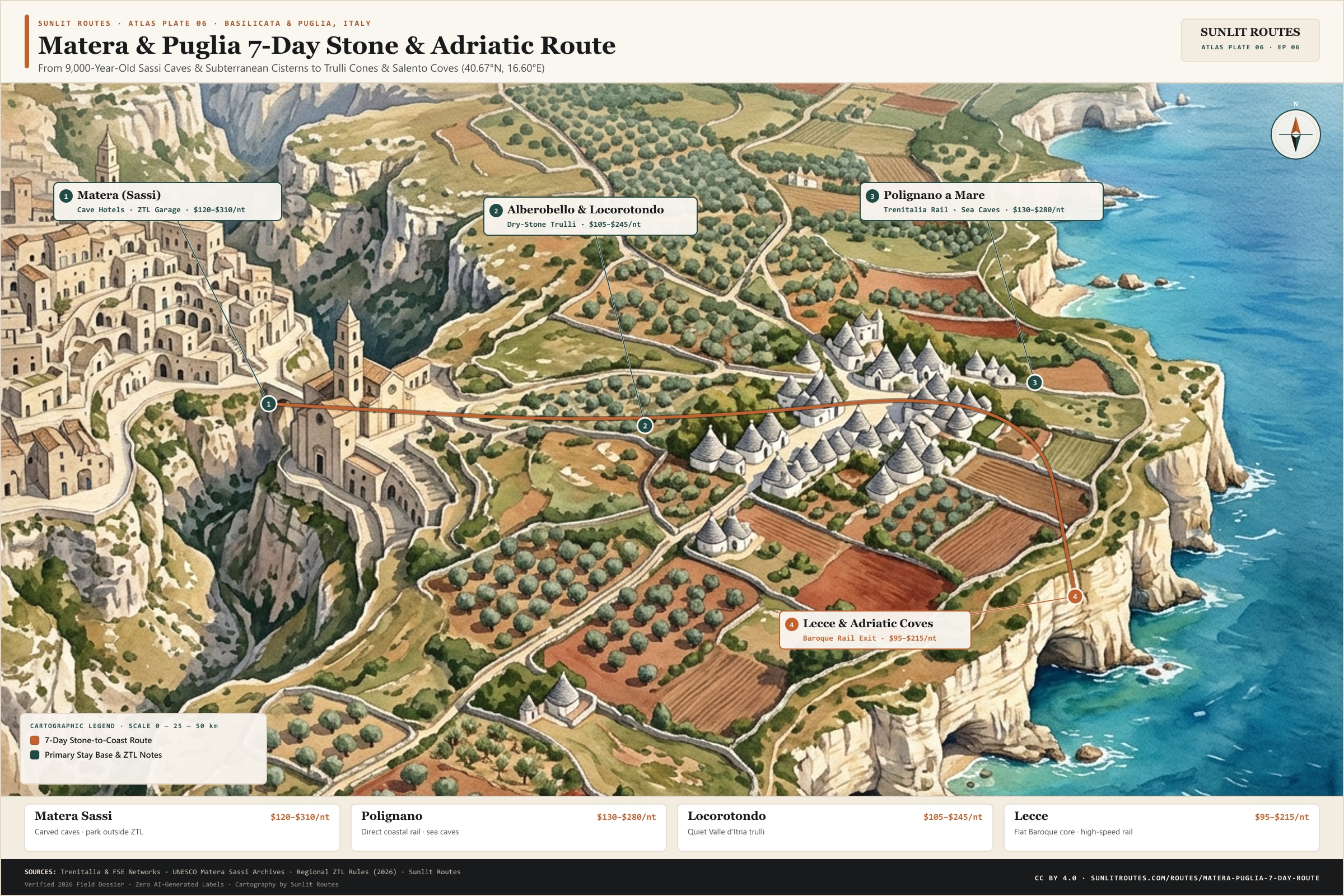
Matera & Puglia 7-Day Stone & Adriatic Route
From 9,000-Year-Old Sassi Caves & Subterranean Cisterns to Trulli Cones & Salento Coves
Plate 06 traces southern Italy's stone-to-Adriatic route across Matera ZTL zones, Trenitalia coastal stations, Valle d'Itria trulli villages, and Lecce.
Primary Sources: Trenitalia & FSE Networks, UNESCO Matera Sassi Archives, Regional ZTL Rules (2026)
Stage-by-Stage Progression
Day-by-Day Route Timeline
Bari Arrival, Altamura Limestone Plateau & Matera Dusk
Pick up your car at Bari Airport (or ride the FAL narrow-gauge train) across the Murgia karst plateau to reach Matera before sunset.
Logistics: 65 km southwest of Bari Airport via SS96 and SS99 (~1 hr); park outside Matera's strict ZTL at Via Saragat or Damasco garage.
Palombaro Lungo Cisterns, Sassi Caveoso & Murgia Gorge
Trace how Matera harvested every drop of rain on a dry limestone canyon, inspect preserved 1950s cave interiors, and cross the suspension bridge.
Logistics: Pre-book Palombaro Lungo entry at the Piazza Vittorio Veneto kiosk; wear gripped walking shoes for slick polished limestone steps.
Alberobello's Dry-Stone Trulli & Locorotondo Hilltop
Cross from Basilicata into Puglia's Valle d'Itria to study mortarless conical stone roofs before settling in quieter Locorotondo.
Logistics: 70 km east of Matera (~1 hr 10 mins via Gioia del Colle); stay in Locorotondo or a countryside masseria to escape tour-bus congestion.
Ostuni 'White City', Cisternino & Ancient Olive Groves
Follow quiet stone-walled lanes past thousand-year-old olive trunks to Ostuni's hilltop lime-washed citadel.
Logistics: Short 20–35 minute countryside drives between Valle d'Itria hill towns; dine on grilled bombette skewers at a Cisternino macelleria.
Polignano a Mare Sea Caves & Monopoli Harbor
Drop down from the olive plateau to the Adriatic limestone cliffs for a morning sea-cave boat excursion and Monopoli's working fishing port.
Logistics: Polignano sits 35 minutes north of Locorotondo by car (or 15 mins south of Monopoli on Trenitalia coastal rail).
Bari Vecchia Pasta Alleys or Direct South to Baroque Lecce
Head south along the Adriatic rail/highway spine into Salento to explore Lecce's honey-colored carved limestone facades.
Logistics: 145 km south from Polignano via SS16/SS379 (~1 hr 35 mins driving, or 1 hr 20 mins on direct Trenitalia Regionale Veloce).
Otranto's Turquoise Cliffs, Bauxite Quarry & Departure
Loop the eastern Salento coast around Otranto's 12th-century mosaic cathedral and crimson bauxite crater lake before returning north.
Logistics: Brindisi Airport sits just 35 minutes north of Lecce; Bari Airport is 1 hour 50 minutes via SS379/SS16.
Accommodation Strategy
Where to Stay: Base-Town Comparison & Map
| Base Town | Vibe | Ideal For | Nightly USD | Trade-Offs |
|---|---|---|---|---|
| Matera (Sassi) | Terraced calcarenite canyon town divided into Barisano and Caveoso quarters | First-time visitors, architecture lovers, and two-night cave hotel stays | $120–$310/night | + Unmatched experience sleeping inside 9,000-year-old carved limestone rooms; effortless walking access to Sassi Caveoso, Palombaro Lungo, and Murgia gorge overlooks. − ZTL vehicle bans require parking in perimeter garages and rolling luggage down stone stairways; summer afternoon heat reflects off pale stone walls. |
| Polignano a Mare | Whitewashed cliffside town perched above Adriatic sea caves | Coastal base stays, boat cave tours, and car-free Trenitalia rail access | $130–$280/night | + Direct main-line Trenitalia railway station linking Bari and Lecce; walkable sea-cliff balconies and Lama Monachile cove; lively evening piazza dining. − Lama Monachile pebble beach packs shoulder-to-shoulder after 10:00 AM in summer; historic-center parking is scarce. |
| Alberobello / Locorotondo | Dry-stone limestone hill towns in the olive-covered Valle d'Itria | Slow travelers wanting quiet countryside masserie and trulli stays | $105–$245/night | + Central launching pad for Martina Franca, Cisternino, Ostuni, and Adriatic beaches (25 mins away); Locorotondo offers calmer evenings than touristy Alberobello. − Ferrovie del Sud Est (FSE) rural trains and buses run slowly with limited Sunday service; a rental car unlocks countryside masserie. |
| Lecce | Warm golden-limestone Baroque university city in southern Salento | Closing the 7-day loop with dining, architecture, and dual-coast day trips | $95–$215/night | + Flat, walkable pedestrian core; markedly better value boutique palazzi than northern Puglia; direct Frecciarossa high-speed rail back to Rome or Milan. − Sits 15–35 minutes inland from Otranto's cliffs and Gallipoli's beaches; peak summer traffic builds along coastal spur roads. |
Transparent 2026 Economics
Real Trip Cost Calculator & Breakdown
2026 Trip Budget Estimator
Matera & Puglia · On-the-ground spend (excl. flights)
$1,414 per person ($202/day incl. shared-room savings).
Covers lodging, local transit, daily meals, and flagship entry fees at 2026 field-verified rates.
| Expense Category | Lean / Budget | Mid-Range | Field Notes |
|---|---|---|---|
| Matera Cave Hotel, Masseria & Salento Stays (per person, double occ.) | $65 | $125 | Central Matera cave guesthouses average $140–$210/night for two; luxury Sassi suites and restored Valle d'Itria masserie run $250–$380/night. |
| Orecchiette, Focaccia Barese & Trattoria Dinners | $30 | $52 | Warm Bari focaccia and espresso run $5–$8; sit-down regional pasta, burrata, and Primitivo wine dinners average $28–$45. |
| Compact Car Rental, Fuel & Perimeter Garages (or Rail) | $20 | $32 | Compact car rentals from Bari (BRI) average $26–$42/day plus $15–$20/night perimeter parking; Trenitalia coastal legs cost $5–$12 each. |
| Palombaro Cistern, Rupestrian Churches & Sea Cave Boat Tour | $15 | $21 | Matera Sassi Pass (~$13 for rock churches), Palombaro Lungo entry ($4), plus amortized Polignano cliff-cave boat trip ($40–$50). |
Vetted Local Operations
Top Bookable Excursions & Passes
 GetYourGuide1.5 hours
Polignano a Mare Sea Caves & Cliffside Coastline Boat Tour
Enters Grotta Palazzese, Grotta delle Rondinelle, and limestone sea arches accessible only from the water, bypassing crowded cliff overlooks.
Photo: Patrick Nouhailler (CC BY-SA 3.0, Wikimedia Commons)
 GetYourGuide2.5 hours
Matera Sassi Guided Historical & Underground Cistern Walk
Connects Sassi Caveoso, frescoed rupestrian churches, and the 1952 evacuation history with architectural context you miss wandering unmarked alleys alone.
Photo: Hervé Simon (CC BY-SA 2.0, Wikimedia Commons)
 GetYourGuide4 hours
Alberobello & Valle d'Itria Trulli & Olive Oil Tasting Tour
Explains dry-stone corbel masonry inside Rione Monti before taking you into working centuries-old olive mills outside town.
Photo: Palickap (CC BY-SA 4.0, Wikimedia Commons)
Nine Thousand Years Carved Into a Waterless Canyon
Stand on Piazzetta Pascoli in Matera as evening light hits the canyon across the Gravina gorge, and the hillside looks less like a constructed city than a biological crust growing directly out of golden limestone. Thousands of arched doorways stack ten tiers high down the cliff wall, so tightly packed that the flat stone terrace outside one household forms the roof of the family living directly beneath it.
For over 9,000 years, humans occupied these natural and hand-chiseled cavities in southern Italy's Basilicata region—making Matera one of the longest continuously inhabited settlements on Earth. Yet as recently as 1952, the Italian government branded Matera's Sassi quarters "the shame of the nation" and passed a special national law evacuating more than 15,000 residents out of dark, malaria-plagued caverns into modern concrete apartments on the upper ridge.
Half a century later, those abandoned rock chambers did a complete economic reversal. Designated a UNESCO World Heritage Site in 1993, the Sassi transformed into Italy's most sought-after architectural stays—where booking a Matera cave hotel puts you inside ancient limestone vaults engineered around an extraordinary hidden water machine.
The Engineering Spine: How Matera Harvested Rain Without a River
1. The Gravity-Fed Viciniato Cistern System
Matera sits high atop a fractured plateau of soft marine calcarenite limestone, roughly 100 meters above the seasonal Gravina stream at the bottom of a vertical gorge. Carrying heavy amphorae up a sheer canyon cliff for drinking water was impossible on a citywide scale. So ancient inhabitants turned the entire terraced hillside into a giant rainwater funnel.
Every paved alleyway, rooftop, and courtyard (vicinato) was pitched at a precise angle to channel winter rainfall down narrow stone gutters into shared bell-shaped subterranean cisterns (palombari) cut straight into the rock beneath communal courtyards. Heavy suspended silt settled into an upper decanting basin before filtered drinking water spilled into the lower sealed chamber, keeping it cool and dark year-round.
2. Palombaro Lungo: The Underground Cathedral
In the 19th century, engineers linked and expanded several natural and excavated cavities directly underneath Matera's main civic square, Piazza Vittorio Veneto, creating Palombaro Lungo—a colossal 5-million-liter subterranean reservoir stretching 50 meters long and 15 meters deep. Workers coated its carved limestone piers in cocciopesto—a waterproof Roman-era plaster made from crushed terracotta tiles and lime mortar—turning porous stone watertight. Today, visitors descend catwalks directly inside the vaulted chamber, seeing the ancient watermarks still staining the walls.
3. Dry-Stone Trulli & Tax-Dodging Architecture in Puglia
Cross east out of Basilicata into Puglia's Valle d'Itria, and the architectural trick changes from subtractive carving to additive dry-stone stacking. The conical trulli of Alberobello and Locorotondo were built strictly from local white limestone slabs stacked in concentric rings (corbeling) with zero mortar. Local feudal records explain the ingenuity: when Kingdom of Naples tax collectors arrived to count permanent houses, peasants could pull a single keystone out and collapse a stone roof into an untaxable pile of field rubble before riders reached the gate—then restack it once inspectors rode away.
Where to Stay in Matera & Puglia: Base-Town Math
Trying to cover Basilicata and the entire heel of Italy from a single hotel adds exhausting highway hours. Splitting seven days across three clean bases—2 nights in Matera, 2 nights in Valle d'Itria or Polignano a Mare, and 2 nights in Lecce—keeps every daily drive under 70 minutes:
- Matera (
Sassi Barisanovs.Sassi Caveoso): Choose Sassi Barisano (north of the Cathedral spur) for slightly smoother access to restaurants, main square terraces, and perimeter parking garages. Choose Sassi Caveoso (south end) for dramatic cliffside silence, proximity to Santa Maria de Idris rock church, and straight sightlines into the Gravina gorge. Both zones ban outside cars; expect $14–$20/night for perimeter garages plus $120–$310/night for restored cave rooms. - Polignano a Mare vs. Alberobello / Locorotondo: Stay in Polignano a Mare ($130–$280/night) if you are traveling by Trenitalia coastal train or want sea-cave boat access and lively Adriatic evenings. Choose Locorotondo or a countryside masseria ($105–$245/night) if you have a rental car and want olive-grove calm away from Alberobello's daytime coach crowds.
- Lecce ($95–$215/night): Puglia's architectural bargain. Built from pale golden pietra leccese stone soft enough to carve like soap when freshly quarried, Lecce pairs flat pedestrian boulevards with notably lower boutique palazzo rates than Polignano or Monopoli.
Day-by-Day 7-Day Matera & Puglia Itinerary
Day 1: Bari Arrival, Altamura Bread & First Dusk in the Sassi
Fly into Bari Karol Wojtyła Airport (BRI), collect a compact rental car (keep it narrow—Apulian hill alleys punish wide SUVs), and drive 65 kilometers southwest across the stony Murgia plateau. Pause twenty minutes in Altamura to pick up a crusty loaf of wood-fired Pane di Altamura DOP baked from local durum semolina.
Roll into Matera before sunset, leave your vehicle at a perimeter garage outside the strict ZTL camera zone (Via Saragat or Autosilo Damasco), and roll a single carry-on down to your cave hotel. Walk out to Belvedere Piazzetta Pascoli just as warm golden light drops and the Sassi stone lanterns flicker on one tier at a time.
Day 2: Palombaro Lungo, Caveoso Rock Churches & the Gorge Crossing
Start at 9:00 AM in Piazza Vittorio Veneto by descending into Palombaro Lungo ($4 timed entry) to understand the hydraulic backbone of the plateau. From there, drop south into Sassi Caveoso to tour Casa Grotta di Vico Solitario—a preserved museum dwelling showing exactly how a family of eight lived alongside a mule in one stone cavern prior to 1952—and climb up into Santa Maria de Idris, a medieval church hollowed directly out of a freestanding limestone pinnacle.
At 3:30 PM, descend the canyon switchbacks to cross the narrow pedestrian Tibetan Suspension Bridge spanning the Gravina stream, climbing up the opposite rim to Belvedere Murgia Timone for panoramic sunset views staring directly back at Matera's terraced cliff face.
Day 3: Alberobello's Dry-Stone Domes & Locorotondo
Depart Matera at 8:00 AM and drive 70 minutes east into Puglia's undulating Valle d'Itria. Beat midday coach arrivals in Alberobello by walking Rione Monti before 10:00 AM, inspecting the two-story Trullo Sovrano, and crossing into quieter Rione Aia Piccola, where residents still live inside genuine mortarless cone dwellings.
For lunch and your two-night base, move ten minutes south to Locorotondo. Perched atop a circular ridge wrapped in whitewashed cummerse gable houses, Locorotondo offers quiet twilight strolls along its balcony lungomare overlooking orderly vineyard patchwork.
Day 4: Cisternino, Millennial Olive Groves & Ostuni
Dedicate a full slow day to the central hill towns. Start with espresso inside Cisternino's quiet medieval arches, then drive the stone-walled backroads down toward the Parco Regionale Dune Costiere, home to twisted monumental olive trees over 1,000 years old.
Spend the late afternoon climbing Ostuni ("La Città Bianca"), whose tightly stacked lime-washed alleys reflect southern sunlight straight back into the sky above a shimmering olive plain. Return to Cisternino for dinner at a local fornello pronto butcher shop, choosing fresh spiced bombette pork rolls straight from the counter to be grilled over wood embers while you sit outside.
Day 5: Polignano a Mare Sea Caves & Monopoli Harbor
Shift thirty minutes northeast to the Adriatic coast at Polignano a Mare. Walk out over the Roman-era bridge spanning Lama Monachile cove before 9:30 AM before beach towels cover every pebble, then board a 90-minute sea-cave boat excursion ($40–$50) cruising beneath the 20-meter limestone overhangs of Grotta Palazzese and neighboring karst arches.
In the late afternoon, drive or hop one local train stop south to Monopoli—an authentic, lived-in harbor town where cerulean wooden gozzo fishing boats bob beneath 16th-century Spanish bastions and calm sandy coves tuck right below the town walls.
Day 6: South to Salento — Lecce's Carved Baroque Stone
Drive or ride a direct Trenitalia Regionale Veloce train south down the Adriatic spine into Lecce (1 hour 20–35 minutes). Walk straight into Piazza Sant'Oronzo to see a sunken 2nd-century Roman amphitheater unearthed beneath the modern cobblestones, then follow Corso Vittorio Emanuele to Piazza del Duomo and the Basilica di Santa Croce—where 17th-century sculptors carved cherubs, griffins, and floral garlands straight into soft cream limestone like wood.
Close the evening in a warm enoteca pairing dry Negroamaro reds with ciceri e tria (handmade pasta ribbons mixed with crispy fried strips and chickpeas).
Day 7: Otranto's Turquoise Cliffs, Bauxite Lake & Departure
Take a final half-day loop 45 minutes southeast to Otranto on the Adriatic tip of Italy. Step inside Otranto Cathedral to examine the vast 1165 AD Tree of Life floor mosaic—spanning the entire nave without breaks—before driving ten minutes south to the Cava di Bauxite, an abandoned open-pit mineral quarry whose rust-crimson earth walls frame a striking emerald-green pool just steps from wild sea cliffs. Return north to Brindisi (BDS) (35 minutes from Lecce) or Bari (BRI) (1 hr 50 mins), or board a direct Frecciarossa train up Italy's spine.
Rental Car vs. Rail Logistics in Puglia & Basilicata
| Route Leg | Rental Car Reality | Car-Free Rail & Bus Reality |
|---|---|---|
| Bari $\leftrightarrow$ Matera | 1 hr via SS96/SS99; perimeter parking required ($14–$20/day) | FAL narrow-gauge train from Bari Centrale (1 hr 35 mins, ~$6; note limited Sunday frequency) |
| Matera $\rightarrow$ Alberobello | 1 hr 10 mins direct across countryside roads | Slow 2-to-3 transfer rail/bus detour via Bari (~3+ hrs) |
| Bari $\leftrightarrow$ Polignano $\leftrightarrow$ Lecce | 1 hr 35 mins via fast SS16/SS379 expressway | Excellent: Direct Trenitalia coastal trains every 30–60 mins ($5–$12) |
| Best Hybrid Strategy | Rent compact car at Bari Airport for Days 1–5; drop in Bari/Brindisi if flying out, or keep through Day 7 for Otranto | Base in Bari + Polignano + Lecce by Trenitalia, adding a guided day shuttle to Matera & Alberobello |
Seasonality Matrix: Heat, Swells & Booking Windows
- May – Mid-June & Mid-September – October (Optimal Window): Warm 22–28°C days, comfortable limestone canyon walking in Matera, and peak Adriatic sea temperatures in September without summer beach gridlock.
- July – August (Peak Heat & Domestic Rush): Inland Matera and Alberobello regularly exceed 36–39°C at midday; Ferragosto (mid-August) fills coastal coves completely and triples cave-hotel rates.
- November – March (Off-Season Calm): Crisp 12–17°C sunny afternoons in Lecce and Matera with peaceful Sassi alleys and 40–50% lower cave-suite rates—though many Adriatic boat tours and countryside beach clubs close for winter.
Connectivity & Travel eSIM Note
Navigating ZTL camera boundary zones outside Matera, Ostuni, and Lecce—plus checking live Trenitalia and FSE regional platform updates or downloading QR museum passes at Palombaro Lungo—depends on uninterrupted mobile data across rural Basilicata valleys. EU and UK travelers benefit from standard roaming rules inside Italy (check UK post-Brexit carrier caps), while US, Canadian, and Australian visitors should install a prepaid Italy or Europe Travel eSIM prior to landing in Bari or Brindisi to avoid airport SIM counter delays.
Practical Field Questions
Frequently Asked Questions
Both quarters lie inside Matera's historic canyon, separated by the Cathedral ridge. Sassi Barisano sits slightly closer to restaurants, Piazza Vittorio Veneto, and perimeter parking garages, while Sassi Caveoso feels rawer, quieter, and closer to the Gravina gorge cliffs and rupestrian rock churches.