Madeira vs. Lanzarote Without a Car (2026): Which Atlantic Island Wins?
Compare Madeira and Lanzarote for car-free travel in 2026: SIGA vs. Arrecife buses, winter-sun microclimates, base towns, and real daily budgets ($115–$200/day).
Key Field Takeaways
- Madeira wins for dramatic vertical hiking, lush laurel cloud forests, and 2,000 km of levada stone aqueducts—at a slightly lower car-free baseline ($115–$185/day) when based in Funchal.
- Lanzarote wins for winter warmth, dry desert-volcanic architecture shaped by César Manrique, and effortless flat cycling or coastal bus loops ($120–$200/day).
- Car-free logistics are straightforward on both islands: Madeira relies on SIGA regional buses plus 2 guided mountain shuttles (PR1 sunrise and West 4x4), while Lanzarote relies on Arrecife Intercity Bus lines plus CACT Timanfaya excursions.
- Weather behaves completely differently: Madeira traps Atlantic clouds on its 1,862-meter northern spine, whereas low-lying Lanzarote stays arid and sunny year-round.
Why Engineers Built 150 Tunnels Through Europe's Floating Cloud Island
Why Madeira's international airport runway rests on 180 reinforced concrete pillars driven into the Atlantic seabed—and why pilots need special certification to land there.
Destination Comparisons
Location Studies & Field Visuals
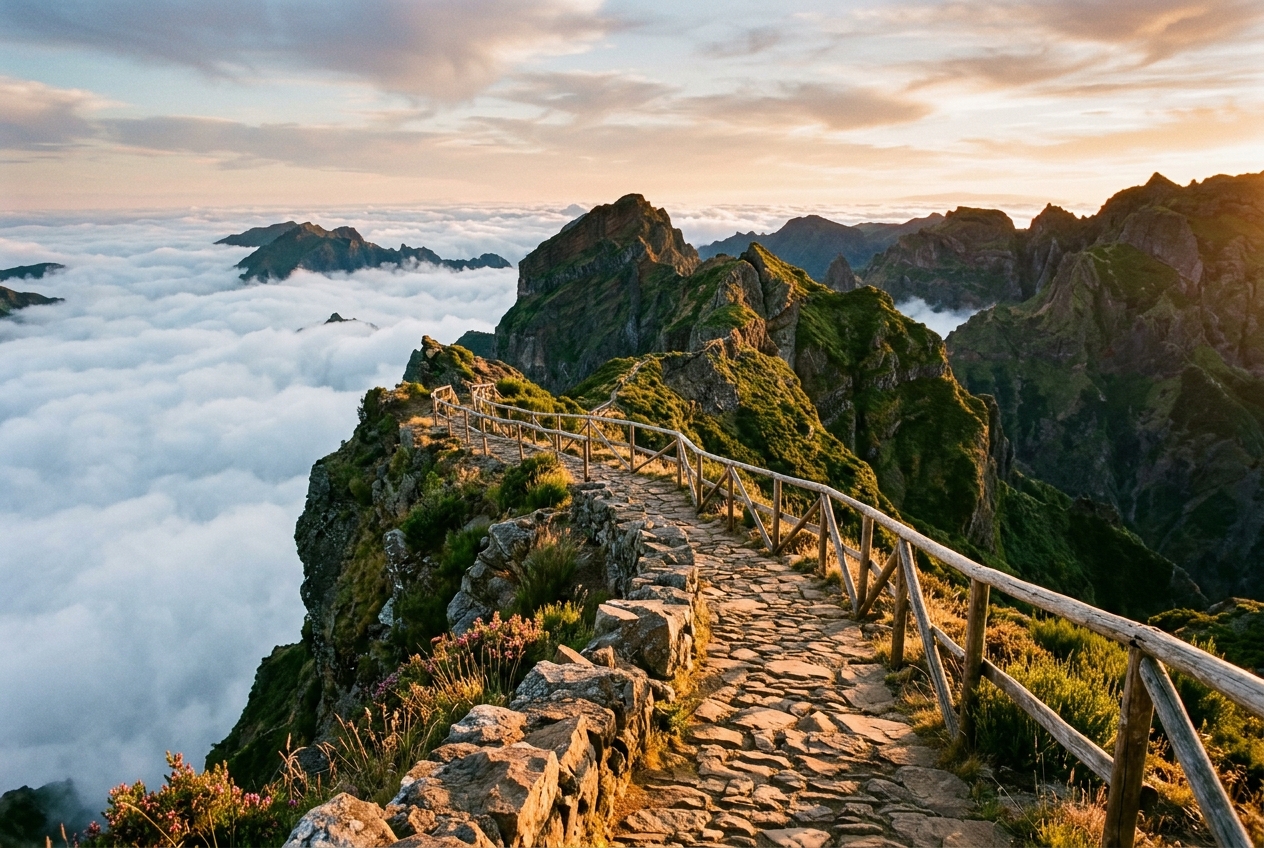
Madeira's vertical basalt coastline forces road engineers into 150 tunnels and walkers onto 15th-century levada ledges.
Funchal serves as Madeira's car-free transit spine, while Ponta do Sol captures maximum south-coast sunshine.
Car-free Madeira averages $115–$185/day including Funchal guesthouses, SIGA buses, and two key mountain shuttles.
Two Volcanic Atlantic Islands, Two Opposite Geographies
Drop a pin in the eastern Atlantic and Madeira and Lanzarote look deceptively similar on a winter-sun search: both are volcanic European archipelagos off the coast of northwest Africa, both sit within a four-hour flight of London or Frankfurt, and both reward travelers who look beyond beachfront resorts. Yet the moment you step off the plane—especially if you are traveling without a rental car—you are stepping onto two radically different geological machines.
Madeira is a steep, emerald vertical fortress. Rising nearly six kilometers from the Atlantic seabed to 1,862 meters at Pico Ruivo, it packs 2,000 kilometers of 15th-century cliffside levada water channels, dripping UNESCO laurel forests, and 150 road tunnels bored straight through basalt into an island just 57 kilometers long. Lanzarote, sitting 480 kilometers further south in Spain's Canary Islands, is a low, arid Martian sculpture shaped by massive 1730–1736 fissure eruptions and protected from skyscraper sprawl by artist César Manrique, whose subterranean lava-tube spaces and whitewashed building codes define the entire island.
If you are choosing between our Madeira 7-Day Route and our Lanzarote 5-Day Volcanic Route for a car-free trip in 2026, this side-by-side breakdown gives you the exact transit math, weather physics, base-town tradeoffs, and daily cost reality.
Side-by-Side Comparison: Madeira vs. Lanzarote (2026)
| Metric | Madeira (Portugal) | Lanzarote (Canary Islands, Spain) |
|---|---|---|
| Recommended Trip Length | 7 Days (Ep 01 Dossier) | 5 Days (Ep 10 Dossier) |
| 2026 Daily Budget | $115–$185/day | $120–$200/day |
| Max Elevation | 1,862 m (Pico Ruivo) | 670 m (Peñas del Chache) |
| Dominant Landscape | Cloud forests, waterfalls, sheer ocean cliffs | Lava fields, volcanic craters, dry-ash vineyards |
| Public Transit Backbone | SIGA regional buses + SAM Aerobus | Intercity Bus Lanzarote (guaguas) + ferry to La Graciosa |
| Car-Free Feasibility | High (with 2 guided mountain shuttles) | High for towns; tour needed for Timanfaya/La Geria |
| Peak Winter Temps (Dec–Feb) | 18–20°C coast; wet/cold at 1,800 m | 20–23°C dry coastal sun |
| Best Base Without a Car | Funchal (Zona Velha / Lido) | Arrecife, Costa Teguise, or Puerto del Carmen |
Landscape & Engineering: Vertical Cloud Walls vs. Subterranean Lava Tubes
Why Madeira Feels Like a Living Hydrological Machine
Madeira's defining feature is how five centuries of settlers solved a sharp rainfall imbalance. Trade winds slam into the central mountain spine and dump heavy mist across northern valleys like Santana and São Vicente while leaving the southern coast dry. Beginning in the 1400s, workers suspended themselves over sheer canyon faces to carve narrow stone aqueducts—levadas—that carry mountain water south by gravity alone.
For car-free hikers, those maintenance footpaths create a trail network unlike anywhere else in Europe. On PR9 Levada do Caldeirão Verde, you walk dead-level stone ledges through mossy laurel walls and four hand-chiseled basalt tunnels to a 100-meter waterfall. On PR6 Levada das 25 Fontes, water springs directly from the moss walls of Paul da Serra. Even arriving feels monumental: Funchal's Santa Catarina runway extends out over the ocean on 180 reinforced-concrete pillars up to 70 meters tall.
Why Lanzarote Feels Like an Architectural Art Gallery on Mars
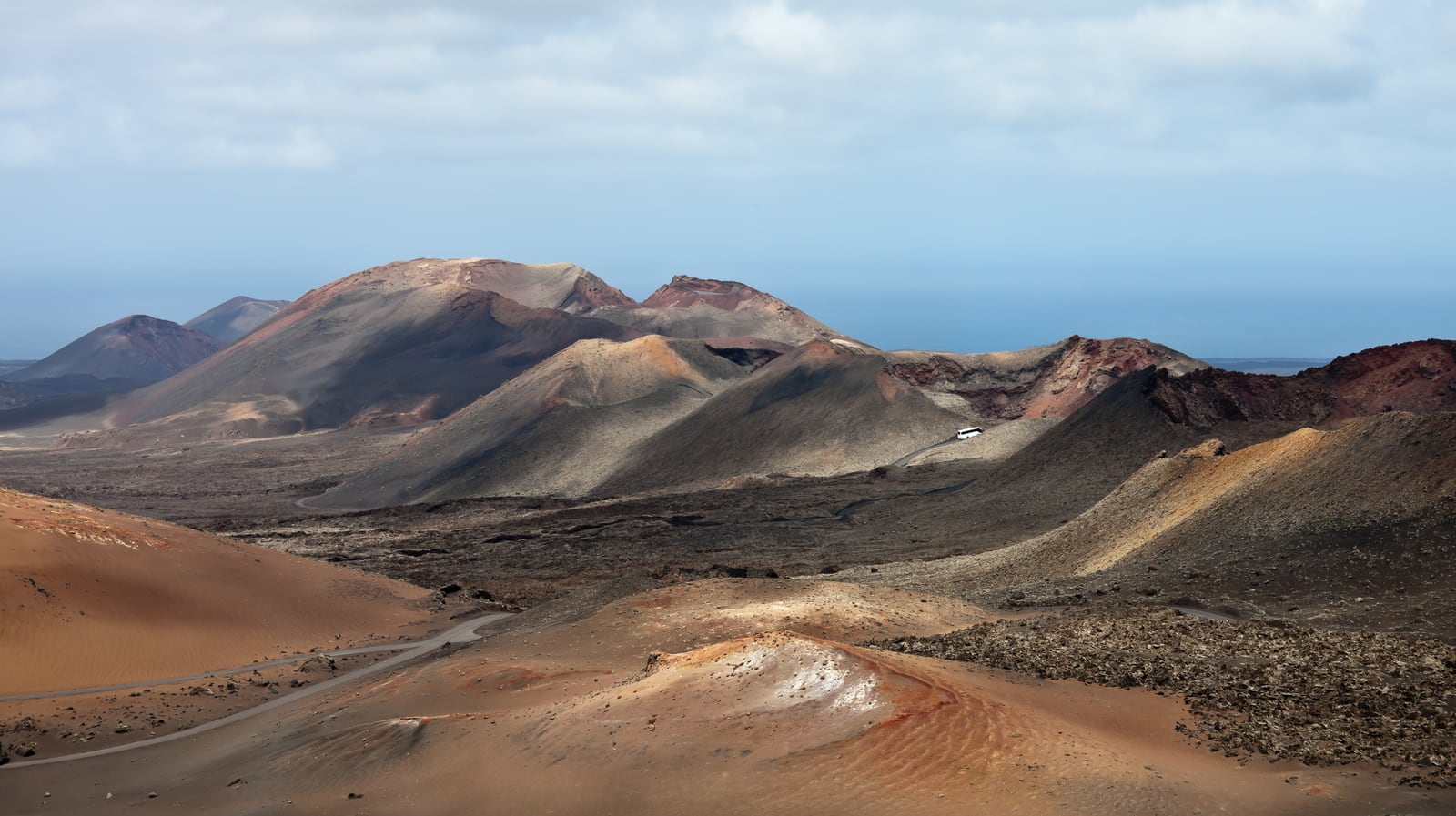
Lanzarote sits low enough that Atlantic moisture mostly sails straight overhead. Between 1730 and 1736, more than thirty craters along the Timanfaya fissure buried a quarter of the island in black basalt and ochre ash (picón). Rather than fighting the barren terrain, farmers discovered that porous volcanic lapilli traps nocturnal dew—leading to La Geria, where thousands of sunken crescent stone walls (zocos) shield individual Malvasía grapevines from Sahara winds.
In the 1960s and 1970s, local artist César Manrique convinced island authorities to ban high-rise concrete hotels and billboards, enforce whitewashed facades with green or blue woodwork, and transform collapsed volcanic lava tubes into public cultural spaces—most notably Jameos del Agua and Cueva de los Verdes. Where Madeira thrills with vertical drama, Lanzarote dazzles with minimalist design carved straight into cooled magma.
Car-Free Transit Reality: SIGA Buses vs. Lanzarote Guaguas
Traveling without a rental car requires honest planning on both islands. Neither island has passenger rail, so you are working with regional buses, airport transfers, and strategic day tours.
Getting Around Madeira Without a Car
Madeira's consolidated regional bus network (SIGA, uniting the historic Rodoeste, Horários do Funchal, and SAM routes) radiates cleanly out of Funchal:
- Airport to Town: The SAM Aerobus runs every 30–45 minutes from FNC into central Funchal for $5.50 (30 minutes).
- Direct Scenic Bus Lines: Route 7 connects Funchal to Câmara de Lobos and the 580-meter Cabo Girão skywalk. Routes 56 and 103 blast straight through the island's mountain tunnels to Santana in 65 minutes for PR9 Caldeirão Verde. Route 113 drops hikers directly at Ponta de São Lourenço (PR8) in 55 minutes.
- Where Buses Cannot Help: Two signature spots require guided shuttles: PR1 (Pico do Arieiro to Pico Ruivo) is a point-to-point ridge traverse above 1,800 meters (book a $35–$49 sunrise shuttle), and Fanal cloud forest has no practical bus service (join an $68 West Island 4x4 tour that links Fanal with Porto Moniz lava pools).
- 2026 Trail Rule: Remember to pay the mandatory $3.25 (€3) Simplifica conservation fee online before boarding buses to PR1, PR6, PR8, or PR9.
Getting Around Lanzarote Without a Car
Lanzarote's Intercity Bus (Arrecife Bus) fleet—locally called guaguas—is reliable, air-conditioned, and inexpensive ($1.50–$4.00 per leg):
- Airport Links: Line 22 (weekdays) and Line 23 (weekends/holidays) connect Lanzarote Airport (ACE) with Arrecife, while Line 161 links the airport directly south to Puerto del Carmen and Playa Blanca.
- North-South Spine: Line 60 runs frequently between Arrecife and Playa Blanca; Line 9 connects Arrecife north toward Órzola (the ferry port for car-free La Graciosa, a 25-minute crossing to white sand beaches and dirt bike tracks).
- The Timanfaya Surprise: Many travelers assume you need a car for Timanfaya National Park—yet private rental cars are banned from the scenic Ruta de los Volcanes anyway. Even drivers must park and transfer onto official park buses. Car-free travelers simply book a CACT / Timanfaya + La Geria + Jameos del Agua guided loop ($55–$75) that covers the volcanic interior cleanly without waiting on low-frequency rural buses in Yaiza or Tinajo.
Transit Winner: Madeira feels slightly more cohesive for independent daily bus adventures because Funchal's tunnel network makes cross-island buses surprisingly fast. Lanzarote is flatter and easier to supplement with e-bikes along coastal promenades, especially between Arrecife, Costa Teguise, and Puerto del Carmen.
Where to Base Yourself Without a Car
Madeira Bases: Why Funchal Beats Ponta do Sol Car-Free
On Madeira, splitting bases only makes sense if you rent a car. Without one:
- Funchal (Zona Velha or Lido, $95–$170/night): Every SIGA intercity route and dawn mountain shuttle picks up here, and Zona Velha's cobbled lanes give you 40+ local tascas serving grilled limpets (lapas) and warm bolo do caco flatbread.
- Ponta do Sol ($110–$210/night): Madeira's sunniest cliff town is magical with a car, but evening bus service drops sharply after 7:00 PM—visit on a day trip or West tour instead.
Lanzarote Bases: Arrecife vs. Puerto del Carmen vs. Playa Blanca
On Lanzarote, your base depends on whether you prioritize bus connections or beach walks:
- Arrecife ($80–$145/night): The island's capital and central bus hub. Less resort-polished than Playa Blanca, but every major intercity bus departs from the Estación de Guaguas, and Charco de San Ginés lagoon offers authentic tapas bars.
- Puerto del Carmen ($95–$175/night): Sits centrally between the airport, La Geria wine region, and Playa Blanca with frequent Line 161 / Line 60 connections and an easy coastal walking promenade.
- Playa Blanca ($110–$210/night): Warmest southern microclimate and ferry port across to Fuerteventura, though farthest from northern Manrique sites like Jameos del Agua and Mirador del Río.
2026 Cost Breakdown: 5–7 Days Side by Side
Use our interactive Sunlit Routes Budget Comparator to test exact day counts, or check the verified daily tiers below:
| Daily Expense Category (Per Person, Double Occ.) | Madeira (Budget / Mid) | Lanzarote (Budget / Mid) |
|---|---|---|
| Accommodation (Guesthouse / Boutique Villa) | $55 / $95 | $60 / $105 |
| Food, Wine & Coffee | $28 / $48 | $28 / $48 |
| Buses, Ferries & Shuttles | $18 / $24 | $14 / $22 |
| Excursions, Gardens & Park Entries | $14 / $18 | $18 / $25 |
| Verified Daily Total (2026) | $115 / $185 | $120 / $200 |
Note: Over a full week, 7 days in Madeira totals roughly $805–$1,295 per person, while 5 days in Lanzarote totals $600–$1,000 per person. Both sit cleanly inside the top tier of car-free European routes under $180/day at the budget level.
Weather & Seasonality: When Each Island Shines
- Choose Madeira in April–June or September–November: South-coast days hover around 21–25°C, mountain visibility is crispest for Pico do Arieiro (PR1), and autumn sea temperatures stay warm (22–24°C) for swimming in Porto Moniz. Always check live NetMadeira ridge webcams at 7:30 AM before riding up into the clouds.
- Choose Lanzarote in November–March: When mainland Europe and Madeira's high ridges turn wet or chilly, Lanzarote holds steady 20–23°C afternoons with abundant sunshine and dramatic low winter light across Timanfaya's red craters. Note that trade winds can pick up briskly in July–August along the northern Famara cliffs.
Final Verdict: Which Should You Book in 2026?
- Book the Madeira 7-Day Route (/go/madeira) if: You live for dramatic mountain hiking, emerald cloud forests, waterfall trails, and lush canyon engineering—and you are traveling between April and November.
- Book the Lanzarote 5-Day Volcanic Route (/go/lanzarote) if: You are chasing guaranteed winter sun (Dec–March), stark volcanic geology, minimalist César Manrique architecture, dry-ash vineyards, and slower coastal afternoons without steep hill climbs.
Still deciding across Europe? Compare both islands alongside Andalusia, Puglia, and the Alps inside our 2026 Budget Comparator or explore our full library of Car-Free Europe Routes Under $180/Day.
Interactive Maps & Cost Calculators
Related Route Dossiers
Practical Answers
Frequently Asked Questions
Madeira is slightly easier for pure car-free walkers because Funchal acts as a single dense transit hub with direct SIGA bus routes (7, 56, 103, 113) and daily mountain shuttles to PR1 and Fanal. Lanzarote's intercity buses link Arrecife, Playa Blanca, and Costa Teguise reliably, though Timanfaya National Park and La Geria wineries still require a guided day tour or short taxi.